Carmelo Anthony’s 3-Word Reply Puts His Hall of Fame Journey in Perspective
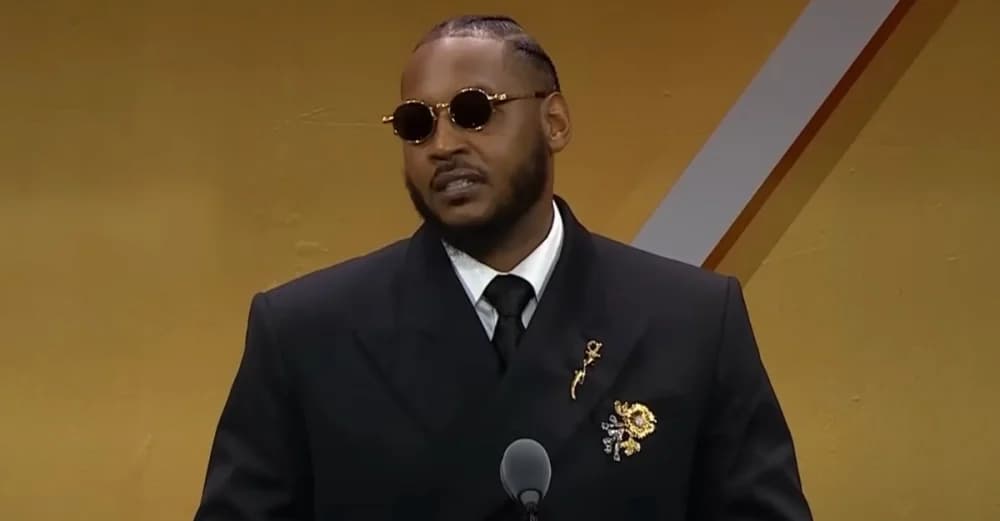
When Carmelo Anthony was officially enshrined into the Basketball Hall of Fame, the celebration did not end with applause alone; it reignited a familiar debate. For years, critics have dissected his résumé, pointing to what it lacked rather than what it showcased. Yet Carmelo Anthony’s 3-word reply was enough to silence the noise: “No regrets!! Respect.” Short, sharp, and layered with meaning, this message came as a direct response to NBA insider Howard Beck’s analysis of Melo’s legacy. Beyond numbers, beyond titles, Anthony’s path from Brooklyn streets to basketball immortality is one marked by grit, loyalty, and an unwavering sense of purpose.
Melo’s Career Under the Spotlight
In his Hall of Fame speech, Anthony laid bare the conflicting narratives that trailed him throughout his 19-year career: “I’ve been cheered, criticized. They called me a scorer who couldn’t win. They said I was too loyal. Then they said I wasn’t loyal enough.”
Beck’s take was candid. No MVPs. No Finals appearances. Just three playoff series wins in nearly two decades. He called the résumé “complicated,” but quickly added, “It’s not the Hall of Perfection.” And he was right. Anthony’s career is better measured through consistency than rings. From his rookie season until the age of 32, he never dipped below 20 points per game. In Denver, he carried the Nuggets to seven consecutive playoff berths, two division titles, and a 2009 Western Conference Finals appearance.
The Choices That Defined Him
Critics often return to the same “what if.” What if Anthony had chosen Miami’s Big Three? Rings almost certainly would have followed. But Melo refused to be a background piece. He chose to chase success on his own terms. That decision may have cost him accolades, but it cemented his identity: not as a passenger in history, but as the author of his own chapter.
Melo’s Why: Purpose Beyond the Court
Anthony’s rise is rooted not only in basketball but in survival. Born in Brooklyn and raised in Baltimore’s rough housing projects, his early life was defined by violence and adversity. Yet he used those experiences as fuel. He lifted Syracuse to its first and only national title before becoming one of the NBA’s most gifted scorers.
His Hall of Fame speech revealed the deeper force that carried him through: “My why was bigger than me. My why was every kid in the hood who ever thought greatness wasn’t for them. My why was my son, who would watch and see if his father would fold or fight.” For Melo, trophies were never the ultimate prize. The true victory was showing resilience, inspiring hope, and proving that greatness could emerge from hardship.
Conclusion
Carmelo Anthony’s 3-word reply is more than a message to critics; it’s a declaration of peace with his journey. No championships? True. No MVPs? Also true. Yet his story stands as proof that impact is not always defined by jewelry or awards. For Anthony, the Hall of Fame is not a shrine to perfection, but a recognition of perseverance, influence, and a career that touched far more lives than the scoreboard ever could.